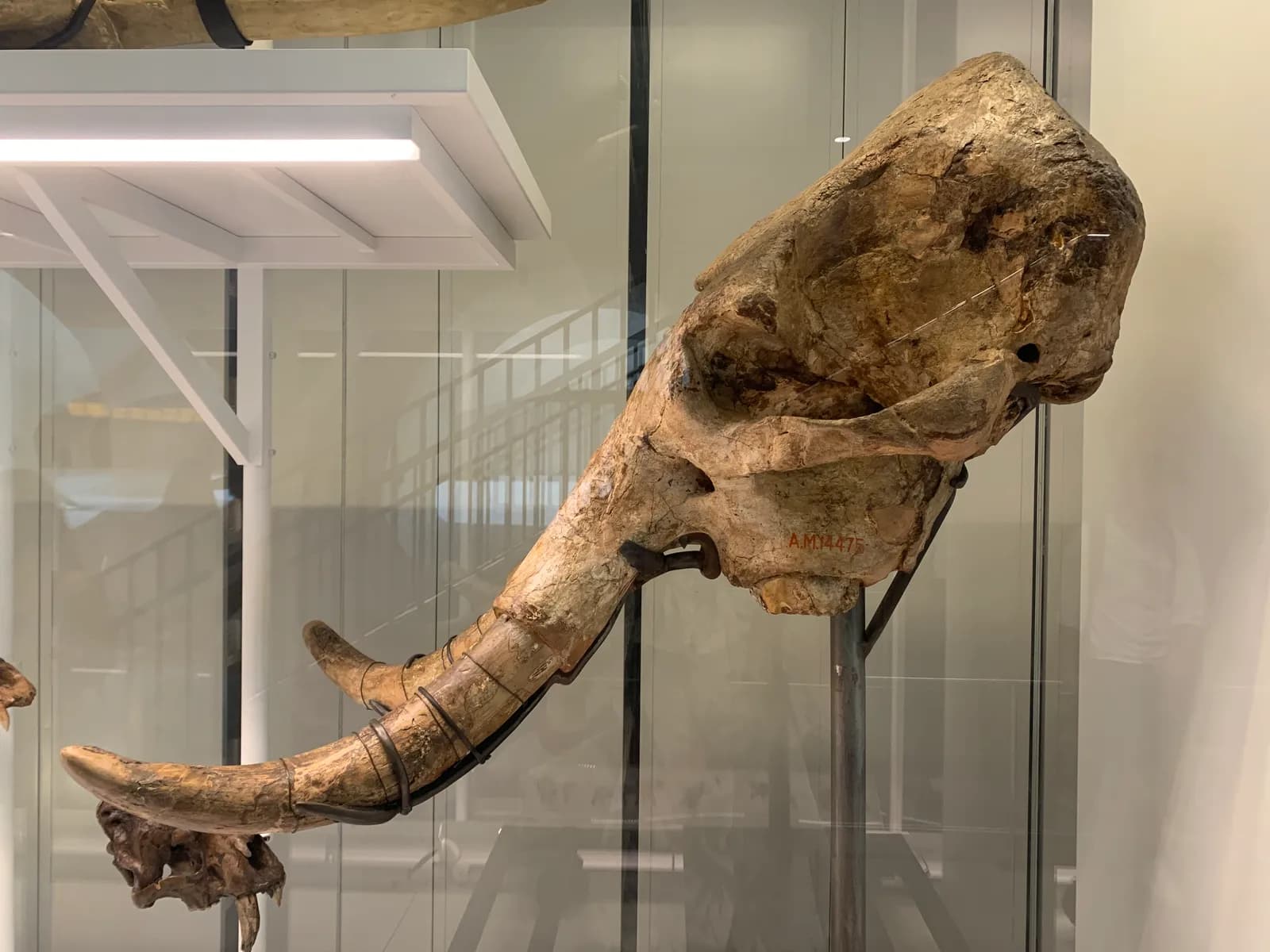
In 1864, workmen digging near what is now Uphall Road in Ilford uncovered a fossil that would place this quiet Essex suburb on the global palaeontological map. The discovery was the only complete mammoth skull ever found in the United Kingdom.
A Victorian Discovery in the Gravel
The skull emerged from the valley gravel that underlies much of Ilford and the surrounding area. This geological formation, laid down during the Pleistocene epoch, has long been recognised as a repository for fossil remains. The 1864 find came at a time of rapid change for Ilford; the railway had arrived a quarter-century earlier in 1839, transforming a rural settlement in the ancient parish of Barking into a growing commuter hub. Construction and excavation work associated with this expansion may have contributed to the discovery.
The precise circumstances of the find, including the identity of those who uncovered it, have not been recorded in available sources. What is established is that the skull was recovered intact, a rarity for mammoth fossils in Britain where specimens are typically fragmentary.
A Specimen of National Significance
The Ilford skull is described as the only complete mammoth skull discovered in the United Kingdom. This distinction makes it a specimen of exceptional scientific importance, offering researchers a rare opportunity to study cranial anatomy without the reconstruction required for partial remains.
The skull was acquired by the Natural History Museum in South Kensington, where it remains part of the permanent collection. The museum's geological galleries have historically displayed the specimen alongside other British fossil elephants, providing visitors with tangible evidence of the megafauna that once roamed the landscape where London now stands.
Local Connections at Redbridge Museum
Residents of Redbridge need not travel to South Kensington to encounter this piece of local heritage. A cast of the Ilford mammoth skull is held by Redbridge Museum, located within the Central Library in Ilford. This replica preserves the connection between the borough and its prehistoric past, allowing local audiences to view a faithful reproduction of the specimen discovered in their area.
The presence of the cast at Redbridge Museum reflects a broader pattern in which local discoveries contribute to national collections while remaining accessible to the communities where they were found. The skull serves as a reminder that Ilford's history extends far beyond its documented settlement patterns into deep time, when the Thames valley supported populations of elephants, rhinoceroses, and other large mammals now extinct in Britain.
Prehistoric Ilford
The Ilford mammoth is not an isolated find. The valley gravels of Essex and Middlesex have yielded numerous Pleistocene fossils, recording a period when the climate fluctuated between glacial and interglacial conditions. The area that is now suburban Redbridge was once tundra-steppe, inhabited by cold-adapted species that migrated across the land bridge connecting Britain to continental Europe.
The presence of these fossils beneath modern Ilford offers a striking contrast between the area's deep past and its present character. Where Victorian workmen once uncovered mammoth remains, commuters now travel to Liverpool Street, and the gravel pits that yielded prehistoric treasures have been replaced by housing, roads, and shops.